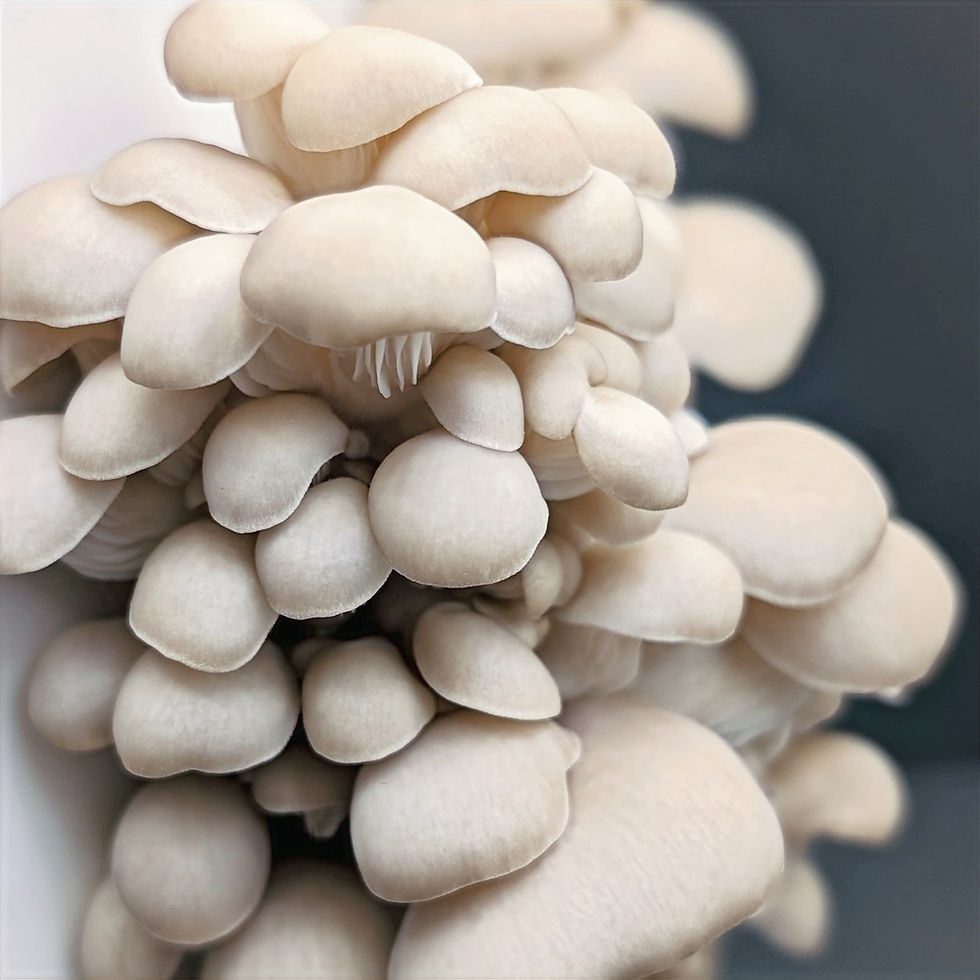
Oyster Mushrooms and Common Supplements — What the Research Compares
Educational content: This article summarizes peer-reviewed scientific research on oyster mushrooms. These statements have not been evaluated by the Food and Drug Administration. Oyster mushrooms are a food — they are not intended to diagnose, treat, cure, or prevent any disease or medical condition. Consult your physician before making dietary changes, particularly if you take prescription medications.
Oyster mushrooms naturally contain lovastatin alongside ergothioneine — which outperforms CoQ10 as a mitochondrial antioxidant because the human body evolved a dedicated transport protein exclusively to absorb it — and beta-glucans that activate immune receptors that echinacea and zinc do not reach. For supplement buyers evaluating their daily stack, the comparison is worth understanding.
On this page
Immune function: beta-glucans vs echinacea and zinc
Mitochondrial protection: ergothioneine vs CoQ10
Cardiovascular health: natural lovastatin vs red yeast rice
The synergy advantage of whole-food matrices
Immune function: how do oyster mushroom beta-glucans compare to echinacea and zinc?
When cold and flu season arrives, consumers reach for echinacea and zinc. These supplements work by stimulating general immune activity and slowing viral replication — broad mechanisms with modest clinical evidence. Oyster mushrooms operate through a more targeted and structurally specific mechanism.
The beta-glucans in oyster mushrooms — particularly pleuran — possess a unique molecular architecture: β-(1,3) backbones with β-(1,6) branching. The human innate immune system recognizes these structures as pathogen-associated molecular patterns and responds by binding them to specialized receptors: Dectin-1, Toll-like receptors, and Complement Receptor 3, located on the surface of macrophages, neutrophils, and natural killer cells. These are pattern recognition receptors that echinacea and zinc do not activate.
Clinical trials demonstrate that oyster mushroom beta-glucans significantly reduce upper respiratory tract infections, prevent the exercise-induced decline in NK cell activity in athletes, and stabilize IgE levels to provide anti-allergic effects. Furthermore, unlike zinc or echinacea, mushroom beta-glucans act as prebiotics in the gut, nourishing the gut-associated lymphoid tissue where the majority of the body's immune cells reside — addressing immune function at the systemic level rather than the symptomatic level.
Mitochondrial protection: why does ergothioneine outperform CoQ10?
CoQ10 is one of the most popular supplements on the market for cellular energy and anti-aging, valued for its ability to support mitochondrial function and protect against oxidative stress. It is a legitimate and well-researched compound. But oyster mushrooms contain a naturally superior alternative for one specific reason: targeted delivery.
The human body cannot synthesize L-ergothioneine, yet it has evolved a transport protein — OCTN1 — designed exclusively to pull ergothioneine from the diet and deliver it into cells experiencing high oxidative stress. Once inside, ergothioneine accumulates preferentially within the mitochondria themselves — not in the surrounding cellular environment, but at the exact site of ROS generation. CoQ10 is an effective antioxidant. Ergothioneine is a targeted intra-mitochondrial shield with a dedicated biological delivery system. The distinction matters for aging, cognitive health, and cellular energy preservation.
Cardiovascular health: how does natural lovastatin compare to red yeast rice?
Red yeast rice has become a staple supplement for natural cholesterol management because it contains monacolin K, a compound structurally identical to the pharmaceutical statin lovastatin. Oyster mushrooms synthesize lovastatin directly and naturally — the same compound by a different route.
But where oyster mushrooms outperform isolated statin supplements is in their dual-action mechanism. Alongside lovastatin, the viscous beta-glucans and dietary fibers in the mushroom form a gel-like substance in the gastrointestinal tract that physically traps bile acids and prevents their reabsorption. Because bile acids are made from cholesterol, this forces the liver to pull circulating LDL directly out of the bloodstream to synthesize new bile — actively driving down systemic cholesterol through a second, independent pathway. Clinical trials in dyslipidemic subjects found that daily oyster mushroom consumption reduced total triglycerides by 36% and total cholesterol by 22% over six weeks, with a separate trial recording an 11% reduction in oxidized LDL.
The synergy advantage that isolated supplements cannot replicate
Isolated supplements like echinacea, CoQ10, and red yeast rice serve specific, targeted functions. They are single-compound or single-class interventions. Oyster mushrooms deliver immune-modulating beta-glucans, mitochondria-protecting ergothioneine, and cholesterol-lowering lovastatin simultaneously in a single whole-food matrix — along with prebiotic fiber, B-vitamins, Vitamin D precursors, and GABA.
The synergy between these compounds is not incidental. Beta-glucans that improve gut microbiome health enhance the absorption environment for every other compound. Ergothioneine that protects mitochondria in immune cells enhances the efficacy of the immune activation triggered by the beta-glucans. Lovastatin that reduces cholesterol is complemented by the beta-glucan fiber that removes cholesterol through an entirely separate mechanism. A supplement stack achieving this would require at minimum four separate products.
What the research shows
In a double-blind multicenter trial of 175 children, six months of pleuran supplementation completely prevented respiratory infections in 36% of treated children compared to 21% in the placebo group, demonstrating immune efficacy that echinacea and zinc trials have not matched at equivalent dosing. Jesenak et al., International Immunopharmacology, 2013.
Clinical trials in dyslipidemic subjects found that daily oyster mushroom consumption reduced total triglycerides by 36% and total cholesterol by 22% over six weeks, while a separate trial recorded an 11% reduction in oxidized LDL — a primary biomarker for atherosclerosis risk. Kajaba et al., Bratislava Medical Journal, 2008.
What this means for your supplement strategy
This is not an argument to stop taking supplements that are working for you. It is an argument that the gap between what a food can do and what a supplement can do is smaller than most supplement marketing implies — and in some cases, the food outperforms the supplement at the mechanistic level. Two to three servings of fresh oyster mushrooms per week delivers the full compound matrix described above. No capsule does.
If you don't have access to fresh oyster mushrooms year-round, we grow and carefully heat-dry them on our closed-loop farm in Virginia's Northern Neck. You can add the full compound matrix to your daily routine with our pure Oyster Mushroom Powder, or our culinary Umami Seasonings built on that same functional foundation. Author's Note: If you are looking for an easy, culinary way to incorporate these functional mushrooms into your daily diet, we offer both pure Oyster Mushroom Powder and crafted Umami Seasonings. We grow our mushrooms on a closed-loop farm in Virginia's Northern Neck and carefully heat-dry them to preserve their full compound matrix. Whether you want the raw powder for your own kitchen or a finished seasoning to elevate your meals, you can explore our farm-grown pantry here.
Sources
Jesenak, M., et al. (2013). Immunomodulatory effect of pleuran in children with recurrent respiratory tract infections. International Immunopharmacology, 15, 395–399.
Kajaba, I., et al. (2008). Clinical studies on the hypolipidemic and antioxidant effects of selected natural substances. Bratislava Medical Journal, 109, 267–272.
Venturella, G., et al. (2021). Medicinal mushrooms: Bioactive compounds, use, and clinical trials. International Journal of Molecular Sciences, 22(2), 634.
Zhang, J.J., et al. (2016). Bioactivities and health benefits of mushrooms mainly from China. Molecules, 21(7), 938.